
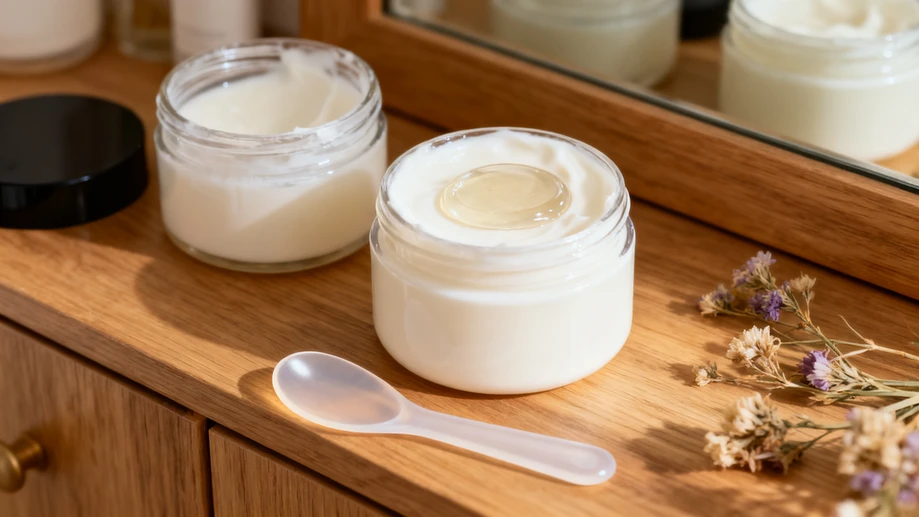
Most people mistakenly throw away slightly separated creamy cosmetic products as spoiled without learning the hidden truth
This common misjudgment causes huge unnecessary waste of high-quality skincare items that use far fewer synthetic emulsifying agents to protect fragile active ingredients
Almost everyone who uses creamy skincare products has encountered this scene at least once: you reach for your regular face cream after not using it for a week during a short business trip, and notice a thin layer of translucent pale oil floating on the top of the originally smooth paste. The first thought popping into most people’s mind is that the product has gone bad and gone through oxidative deterioration, and they will directly walk to the trash can and toss the whole jar without any hesitation. Even a large number of popular beauty content creators will warn their followers that any form of stratification of paste cosmetics represents quality collapse, and people must stop using it immediately to avoid irritating the facial skin. Few people take a closer look at the specific state of the product before making the decision, and this widespread misunderstanding has caused a large amount of completely usable cosmetic products to be discarded every year around the world.
The core of the problem lies in the emulsification system of all water-in-oil or oil-in-water cream products, which is the key technology that determines whether the oil phase and water phase can be stably mixed together for a long time. Synthetic emulsifying agents work like a bridge between water molecules and oil molecules, connecting two components that would otherwise automatically separate to form a uniform and smooth paste texture. If cosmetic manufacturers add a large enough amount of strong synthetic emulsifiers into the formula, the finished cream can keep a perfect uniform appearance even if it is placed in a high temperature environment of more than 40 degrees for several consecutive hours, and no trace of oil spillage or stratification can be observed at all. However, a growing number of cosmetic research findings in recent years have confirmed that excessive intake of emulsifying agents in skincare formulas will gradually erode the sebum lipid barrier on the outermost layer of the skin, leading to long-term hidden problems such as reduced skin tolerance and frequent unexplained redness.
For this reason, more and more formula developers of mild, skin-friendly skincare products choose to reduce the total amount of synthetic emulsifiers as much as possible on the premise of ensuring basic safety, so as to minimize the extra burden of inert ingredients on the skin. Under this formula design idea, the finished paste products will inevitably lose the super-strong anti-separation ability that comes with excessive emulsifiers. When the ambient temperature fluctuates slightly, or the product is left still for more than ten days without being stirred at all, a very small amount of oil phase that is not tightly locked will separate out from the paste and float on the top to form the thin oil layer that people usually see. This slight separation is not a sign of microbial contamination or ingredient deterioration at all, but a natural physical change that does not affect the actual efficacy and safety of the product in any way.
There is a very simple and operable standard to distinguish this harmless slight oil separation from real product spoilage. If the only abnormal state of the cream is a thin layer of oil on the surface, the color of the whole paste does not change, no sour or peculiar fermented smell comes out, and no mold spots of any color grow inside the paste, all you need to do is take a clean, dry cosmetic spatula to gently stir the whole cream a few times, and the separated oil phase can be fully mixed back into the paste to restore its original smooth texture. The user can still get exactly the same use experience and skincare effect as before, and there is no need to discard the whole jar of product at all. As long as the product is still within the valid shelf life, and has not been placed in a high temperature and humid environment for a long time in an unsealed state, the possibility of real spoilage is almost zero under this situation.
This little knowledge can even become a practical reference for people to screen out more skin-friendly cosmetic products in daily life. If a certain cream product you use never shows any trace of oil separation even after you have repeatedly placed it in different temperature environments for more than half a year, you may wish to check the ingredient list carefully to see if there are too many strong emulsifying components listed in the top half of the list. Of course, it is also very important to remember the warning line that cannot be crossed: once the paste has completely turned into a water-like thin liquid, gives off obvious sour or rancid smell, or is covered with colored mold spots, it means that it has been seriously contaminated by microorganisms, and you must discard it immediately to avoid unnecessary skin irritation problems.