
The Secret Language of Your Vanity
Unlocking the science behind everyday beauty rituals
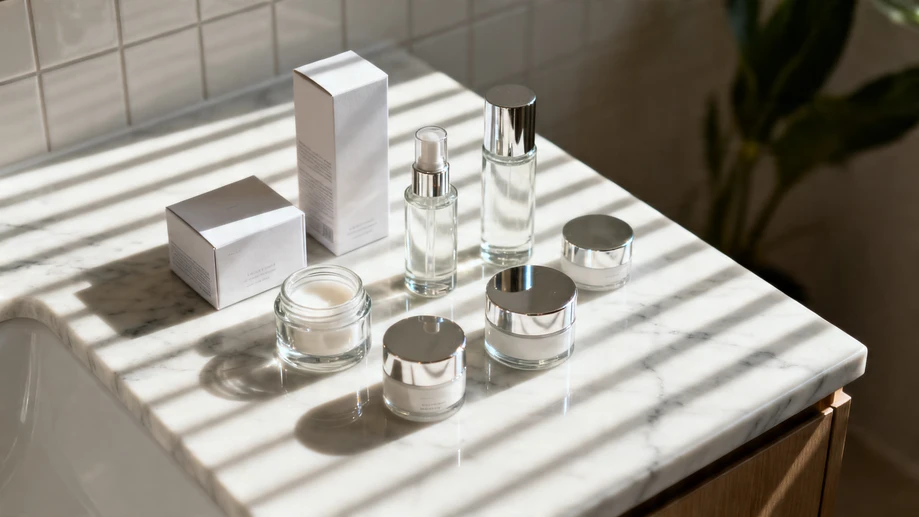
Morning light filters through a bathroom window, illuminating a curated collection of glass and plastic vessels arranged with intentional space between them. Each product occupies its own territory on the cool marble countertop—a cleanser beside the sink, serums aligned by height, moisturizers near the mirror. This deliberate spatial arrangement isn't mere decoration; it creates an ecosystem where formulations remain stable, protected from humidity near showers and direct heat from windows. The distance between bottles prevents chemical cross-contamination while allowing quick visual identification. A well-organized vanity mirrors laboratory precision but adapts seamlessly to domestic life, reflecting an understanding that cosmetic efficacy depends on controlled environments as much as innovative ingredients.
Consider a hydrating serum positioned away from steamy zones: its transparent dropper bottle contains hyaluronic acid molecules that attract moisture from the air. In humid climates, this humidity shield becomes part of the product's function. Conversely, dry environments require richer creams in airtight containers to prevent evaporation—ceramide-infused textures in opaque jars block light degradation while maintaining skin barrier integrity. Sunscreen stands ready near exits, its formula stabilized by opaque packaging against UV-induced decomposition. Each product's placement and design respond to invisible environmental dialogues: temperature fluctuations, ambient moisture levels, and light exposure. Manufacturers engineer these vessels knowing bathrooms transition from cool nights to steam-filled mornings, creating packaging that acts as a protective capsule for delicate chemical alliances.
Lipstick bullets and powder compacts illustrate ingenious material science adapted to unpredictable environments. A refillable metal lipstick case offers thermal regulation, preventing wax separation during summer heatwaves. Powder foundations contain silica microspheres that absorb facial oils throughout the day, performing reliably from air-conditioned offices to humid commutes. The magnets securing compact mirrors are precisely calibrated to survive daily drops onto tiled floors. These portable items frequently migrate from bedroom vanities to handbags, demanding resilience against temperature shocks and physical impacts. Their formulations incorporate flexible polymers and temperature-stable pigments that won't crack in winter or melt in summer, demonstrating how mobility requirements shape cosmetic chemistry far beyond laboratory ideals and into lived realities.
Preservation systems operate as silent guardians within cosmetic containers, maintaining integrity against microbial invasions accelerated by humid environments. Cleverly integrated pumps in lotion bottles create vacuum seals that prevent oxidation—crucial for vitamin C serums prone to degradation upon air exposure. Shampoo formulas counter hard water minerals with chelating agents, ensuring lather consistency regardless of regional water quality. The preservatives parabens have been succeeded by radish root ferment and honeysuckle extracts, offering gentler protection while navigating bathroom humidity. These invisible chemical networks function optimally within specific temperature ranges, explaining why skincare refrigerators gain popularity; they replicate the cool, dark storage conditions that prolong antioxidant potency in delicate formulations.
Sustainability considerations now influence product architecture, with refillable compacts and biodegradable tubes designed to reduce landfill burdens. Bamboo caps and algae-based plastics decompose naturally yet withstand moisture exposure. Cream jars with weighted bases remain upright during earthquakes, while slender bottles allow space-efficient medicine cabinet storage. Even disposal mechanisms reflect environmental adaptation: airless pump bottles expel 95% of product to minimize waste, and tube designs incorporate flat bottoms to stand vertically. This marriage of functionality and ecology manifests in products that fit seamlessly within modern recycling systems, their colors and materials chosen for compatibility with municipal sorting technologies. Packaging engineers scrutinize every ridge and curve to ensure bottles roll correctly on conveyor belts, turning vanity staples into participants in larger ecological dialogues.
The harmony between cosmetics and their environments represents an ongoing negotiation between science and daily life. From temperature-responsive textures to space-saving designs that accommodate small apartments, these innovations transform ordinary bathrooms into personalized beauty laboratories. By understanding how light, air, and moisture interact with formulations, consumers can optimize product lifespans—storing oils in dark cupboards, keeping acids away from heat vents, recognizing when separation or discoloration signals environmental incompatibility. This knowledge unveils the hidden intelligence within every bottle and jar, revealing cosmetics not as isolated luxuries but as dynamic elements integrated into our living spaces, responding to and shaping the environments they occupy.