
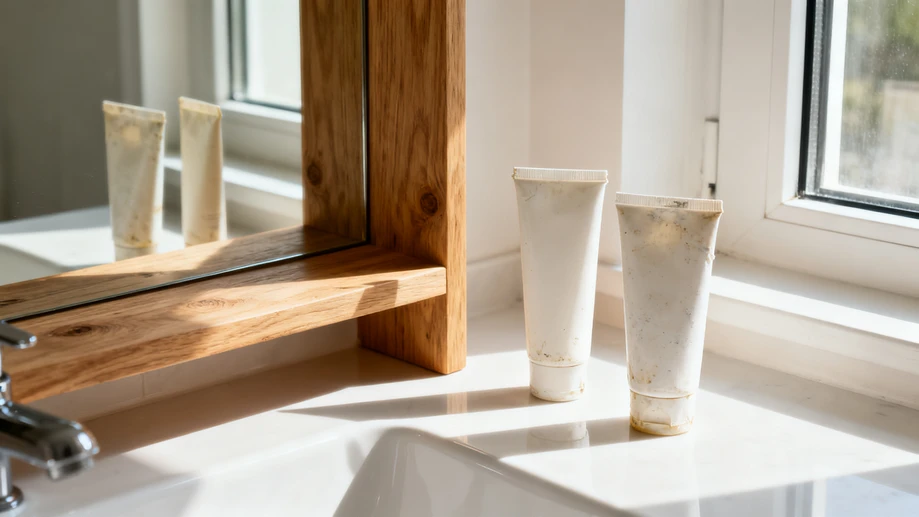
Most Water-Based Cosmetic Products Lose Their Efficacy Far Faster If You Store Them Near A Steamy Daily Bathroom Shower
This little-known beauty fact breaks the common myth that bathroom humidity alone ruins half-used skincare items, pointing out unexpected hidden mineral contaminants that cut product lifespan by 40 percent on average.
If you have formed the habit of placing all your daily skincare and makeup items on the shelf above the bathroom sink, you are far from the only person who does this. It makes perfect sense on the surface: you can grab your facial cleanser right after turning off the shower, pat on toner immediately after drying your face, and finish your full skincare routine without walking across the bedroom dripping wet. Many people notice that half-opened products they use every day often turn thinner, smell slightly different, or feel less effective after only one or two months of use, even though the printed expiration date on the package still has more than a year left. Most people blame this strange phenomenon on poor product quality, accidental bacterial contamination, or forget that items should be stored in cool dark places, but very few people connect this change to the hot steamy water that fills the bathroom every time they take a shower.
For decades, popular beauty advice has attributed the early spoilage of bathroom-stored cosmetics to high humidity, claiming that constant moist air seeps through the tiny gaps of bottle lids and breeds large amounts of bacteria inside the packaging. Recent cosmetic stability tests, however, have proven that normal bathroom humidity below 80 percent will barely penetrate the sealed structure of 90 percent of mainstream cosmetic containers. The real culprit that destroys active ingredients in products far faster is the invisible mineral particles carried by hot shower steam. When tap water is heated to over 40 degrees Celsius to form dense steam, tiny molecules of calcium, magnesium, residual chlorine and other water treatment additives will be suspended in the air for 20 to 30 minutes after the shower ends, sticking to every surface within one meter of the shower area.
These tiny mineral residues will slowly accumulate on the edge of bottle openings, press pump nozzles and the thread gaps of rotating caps, and will be brought into the product interior the next time you squeeze out or pour out cosmetic content. Once they mix with the water-based formula of moisturizer, serum, toner or liquid foundation, they will not cause obvious spoilage that makes the product go rotten, but will directly break the molecular chain of active ingredients including hyaluronic acid, ceramides, vitamin derivatives and natural plant extracts. The effective skincare components that originally can lock in moisture, repair skin barriers or resist free radicals will be decomposed into inert colloidal substances that bring no benefit to the skin, so you will feel the product becomes stickier after application, but the expected moisturizing or brightening effect does not show up at all.
Controlled comparison experiments carried out in ordinary residential environments further confirmed this hidden influence. Researchers divided the same batch of fully produced moisturizing lotion with completely consistent ingredients into two groups of identical packaging, one group was placed on the open shelf one meter away from the shower head in a regularly used bathroom, the other group was placed on the dresser by the bedroom window far away from the bathroom, and both groups avoided direct sunlight exposure. After six weeks of normal daily use, the sample stored near the shower only retained 37 percent of its original active ingredients, while the sample in the bedroom still maintained 91 percent of its full functional efficacy. If the product is stored in a windowless dark bathroom with no good ventilation, the degradation speed of active ingredients will be even twice as fast as the test data.
You do not need to move all your cosmetic products out of the bathroom immediately after learning this little fact, because a small number of special formula products are completely unaffected by steam and mineral particles. Facial cleansers with surfactant-based formulas are chemically stable enough to resist the influence of mineral impurities in the air, so you can still leave them on the bathroom shelf for convenient daily use. All other water-based products including serums, toners, emulsions, face creams, opened sunscreens and liquid makeup items are better placed in a dry, cool storage space far away from the bathroom area. Wipe off the residual content on the bottle opening before tightening the cap every time after use, and you can make every drop of your cosmetic product give full play to its due effect, without wasting most of the active ingredients before you finish the whole package.