
The Pigmented Poetry of Eyelids
When Color Finds Its Canvas
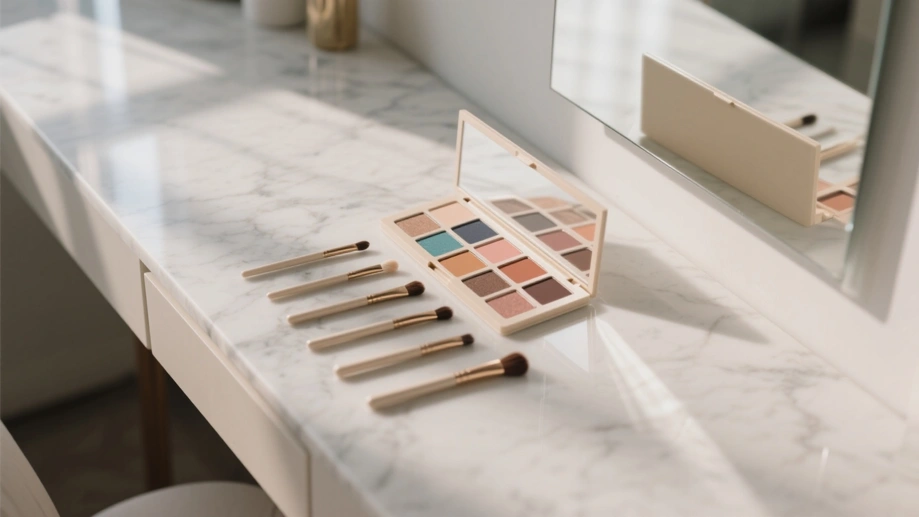
Sunlight catches the arrangement on a minimalist vanity: velvet-textured palettes resting beside sleek brushes, their orderly alignment creating visual harmony on the marble surface. These compact universes of pigment, known as eye shadows, transform lids into dynamic landscapes. Their fine powder compositions blend mica minerals with iron oxides and ultramarine pigments, ground finer than beach sand. Each pressed particle adheres through electrostatic attraction, requiring no chemical solvents to maintain structure. Unlike lipstick tubes or foundation bottles, these flat square compacts slide effortlessly into dressing table organizers or travel kits, their slim profiles complementing modern lifestyle accessories.
Centuries ago, crushed malachite and lapis lazuli adorned Egyptian royalty, stored in alabaster jars beside kohl pots on stone shelves. The Renaissance saw saffron-infused powders in Venetian glass containers displayed as luxury objects in aristocratic chambers. Modern mass production emerged alongside 20th-century cinema, with starlets' metallic looks requiring accessible pressed powders in practical plastic cases. Today's formulations preserve this historical essence while adapting to contemporary storage aesthetics - palettes stack neatly like miniature art books or magnetically attach to modular makeup systems. This evolutionary journey reflects shifting cultural values about beauty rituals, where once ceremonial objects have become democratized daily essentials.
Varieties reveal themselves through texture and interaction. Matte shadows like desert sands absorb light in their kaolin clay base, their velvet finishes resisting fingerprints on packaging surfaces. Shimmer varieties contain light-refracting borosilicate particles that scatter illumination like crushed diamonds when containers catch daylight. Cream formulas suspend pigments in wax-oil emulsions, housed in weighted jars that sit stably on uneven surfaces. Temperature-responsive metallics transform application under warm fingertips, their liquefying properties enabled by thermochromic capsules undetectable to the naked eye. Each type demands specific storage conditions: powders away from bathroom humidity that causes hardening, creams avoiding sunlit windowsills where heat accelerates separation.
Color relationships follow principles observable in nature. Analogous palettes mimic sunset gradients - peaches blending into terracottas like dawn horizons. Complementary duos recreate floral contrasts: violet against sunflower yellow reflecting orchid petals. Monochromatic trios replicate geological stratification, from slate grey to charcoal black resembling sedimentary rock formations. Pigment concentration determines chromatic intensity - a mere 15% titanium dioxide creates pastels as soft as magnolia blossoms, while 40% concentration yields jewel tones like stained glass. These chromatic systems explain why certain palettes feel intrinsically harmonious on display shelves, their color sequencing satisfying spatial aesthetics without conscious design effort.
Beyond decoration, eye shadow chemistry incorporates functional innovation. Photochromic particles respond to UV exposure, their subtle daytime shift visible only in natural light. Mineral-based versions leverage zinc oxide's anti-inflammatory properties, soothing while coloring. Magnetic packaging solutions allow component rearrangement, satisfying organizational tendencies. Biodegradable plant-based compacts now coexist with refillable metal cases, aligning with sustainable interior design trends. The industry's future pivots toward responsive technologies where nanocapsules release pigment upon contact with skin's natural warmth, potentially revolutionizing storage and application dynamics by eliminating traditional brushes and compacts.